Recently, the research group led by Professor Xu Dake, part of Professor Wang Fuhui's team at the School of Materials Science and Engineering, made significant advances in the microbial recycling of spent lithium-ion batteries. The related results were published in Journal of Hazardous Materials under the title "Lactiplantibacillus plantarum Enables Metal Recovery from Spent LiNi0.33Co0.33Mn0.33O2 Cathode via EPS-Mediated Synergistic Bioleaching" (DOI:10.2139/ssrn.6071904). Professor Xu Dake and Associate Professor Zhang Danni are co-corresponding authors. Doctoral student Li Min from the School of Life Sciences and Health, master's student Wang Hong from the School of Materials Science and Engineering, and Associate Professor Zhang Danni are co-first authors. NEU is listed as the first completion institution and the sole corresponding institution.
The massive retirement and accumulation of spent lithium-ion batteries have become a key bottleneck restricting the green development of the new energy industry. Traditional strong-acid hydrometallurgical recovery processes present prominent problems, including high environmental pollution risks and poor economic performance. Therefore, developing new green hydrometallurgical recovery technologies for spent battery cathode materials that operate under mild conditions and are environmentally friendly, safe, and sustainable has become an important research direction in the fields of resource recycling and environmental materials.
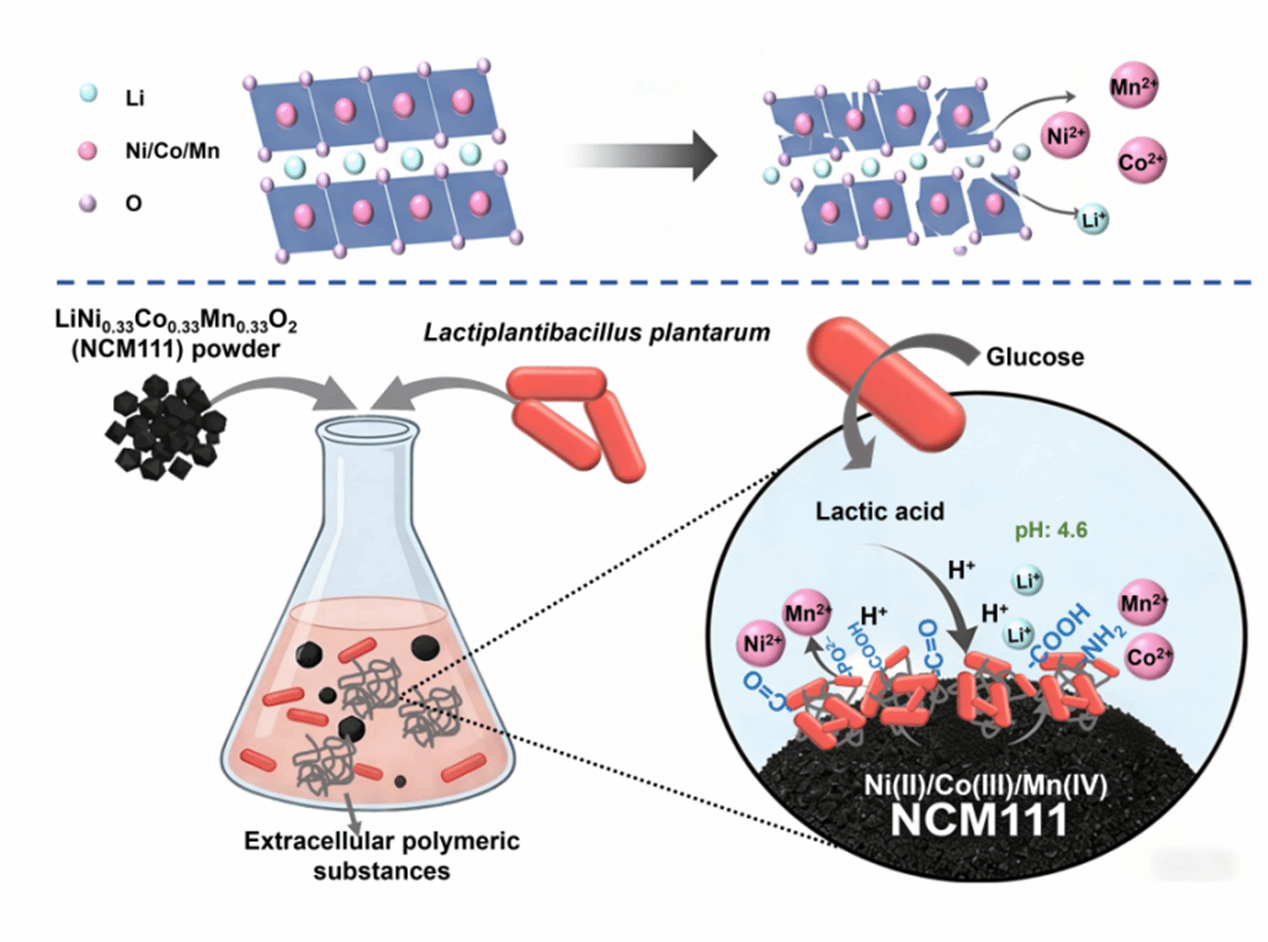
Figure 1. Schematic diagram of the synergistic leaching of metal ions from spent NCM111 cathode materials by L. plantarum and EPS
This study used the weak acid-producing bacterium Lactiplantibacillus plantarum (L. plantarum), a biosafety level 1 organism, to achieve efficient bioleaching of spent NCM111 cathode materials under mild acidic conditions of pH 3.9–4.1. At a solid–liquid ratio of 5.0 g/L, the one-step co-culture strategy achieved leaching rates of 54.5%, 46.1%, 45.1%, and 45.5% for Li, Ni, Co, and Mn, respectively, within 7 days. The addition of 100 mg/L extracellular polymeric substances (EPS) into the system further increased the leaching efficiencies to 62.7%, 60.7%, 53.0%, and 53.0%. By promoting bacterial adsorption on the material surface to form a biofilm-like structure, EPS strengthened the microorganism–mineral interfacial interactions, enabling an efficient synergy between acidolysis and redox reactions. Transcriptomic analysis showed that L. plantarum could resist heavy metal stress by upregulating nucleotide synthesis, antioxidant systems, and amino acid metabolism. Exogenous EPS specifically regulated sulfur and selenium metabolic pathways. This regulation enhanced bacterial tolerance to oxidative stress, maintained high metabolic activity, and improved leaching efficiency. The process operates under mild conditions and is green and safe. Production costs can be further lowered by substituting low-cost agricultural by-products such as molasses for conventional culture media. The leaching residues are amenable to secondary resource recovery and re-leaching. The modular design is suitable for distributed recycling scenarios of small and medium-sized spent lithium-ion batteries, indicating promising prospects for industrial application.
This study constructed a green biological recovery system for spent ternary cathodes based on mild probiotics, breaking through the technical limitations of traditional hydrometallurgy, which relies on strong acids and causes severe pollution. It provides a new strategy for the efficient, safe, and low-carbon recycling of spent lithium-ion batteries. The system also demonstrates significant application value in fields including power battery recycling, solid waste resource utilization, and environmentally friendly metallurgy. This research was supported by the National Science Fund for Distinguished Young Scholars and the Liaoning "Xingliao Talents" Plan.


