Recently, the research groups of Professor Derek Lovley and Professor Xu Dake at the Interdisciplinary Research Center for Electroactive Biomaterials of NEU made significant progress in Fe(III) reduction research. The study revealed for the first time that the marine respiratory anaerobe Desulfovibrio ferrophilus can reduce Fe(III) through endogenous naphthoquinone electron shuttles without relying on its outer membrane cytochromes. The research results were published under the title "Fe(III) oxide reduction bypassing outer-surface cytochromes in a marine respiratory anaerobe" in Environmental Science & Technology (a Nature Index journal, DOI: 10.1021/acs.est.6c04532), a leading international journal in the environmental field, and was featured as a supplementary cover article. Li Jiaxin, a doctoral student from the School of Medicine and Bioinformatics Engineering, is the first author. Professor Derek Lovley and Professor Xu Dake are the co-corresponding authors. NEU is listed as the first completion institution.
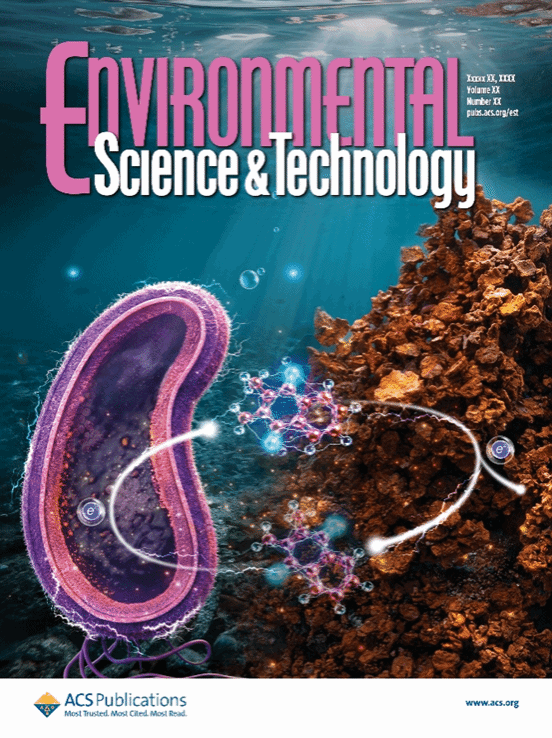
Cover image
Microbial Fe(III) reduction is a key process in carbon cycling and redox reactions in anaerobic environments. For a long time, related mechanisms have mainly focused on freshwater model strains Shewanella and Geobacter, and there has been a lack of direct experimental evidence for marine respiratory anaerobic bacteria. This study used the marine sulfate-reducing bacterium D. ferrophilus as a model organism to systematically evaluate its Fe(III) reduction mechanism. The study found that although D. ferrophilus expresses multiple outer membrane c-type cytochromes, its cell suspensions cannot reduce Fe(III), indicating that effective electron transfer contact points are absent on the outer surface. Mutant strains lacking outer membrane-associated cytochromes, constructed through gene editing technology, were still able to reduce Fe(III) oxides normally, confirming that these cytochromes are not essential. Further research shows that the bacterium secretes multiple naphthoquinone electron shuttles during Fe(III) reduction. These shuttles transfer electrons through a cyclic mechanism that involves intracellular reduction followed by shuttling back to the extracellular environment, and this process is independent of outer membrane cytochromes. The study expands the understanding of extracellular electron transfer (EET) mechanisms in respiratory anaerobic bacteria and provides key theoretical support for improving biogeochemistry models and interpreting omics data. This mechanism also reveals a novel extracellular electron transfer pathway of marine sulfate-reducing bacteria, which is of great significance for understanding the reduction of iron oxides and the transformation of corrosion products during microbiologically influenced corrosion (MIC). It also provides a new approach for corrosion protection strategies based on electron shuttle regulation. The study emphasizes that systematic functional investigations of environmental isolates with different extracellular electron transfer mechanisms are a necessary prerequisite for accurately linking genomic potential to environmental functions.
This research was supported by the Key Program of the National Natural Science Foundation of China, the National Science Fund for Distinguished Young Scholars, and the National Key R&D Program of China.
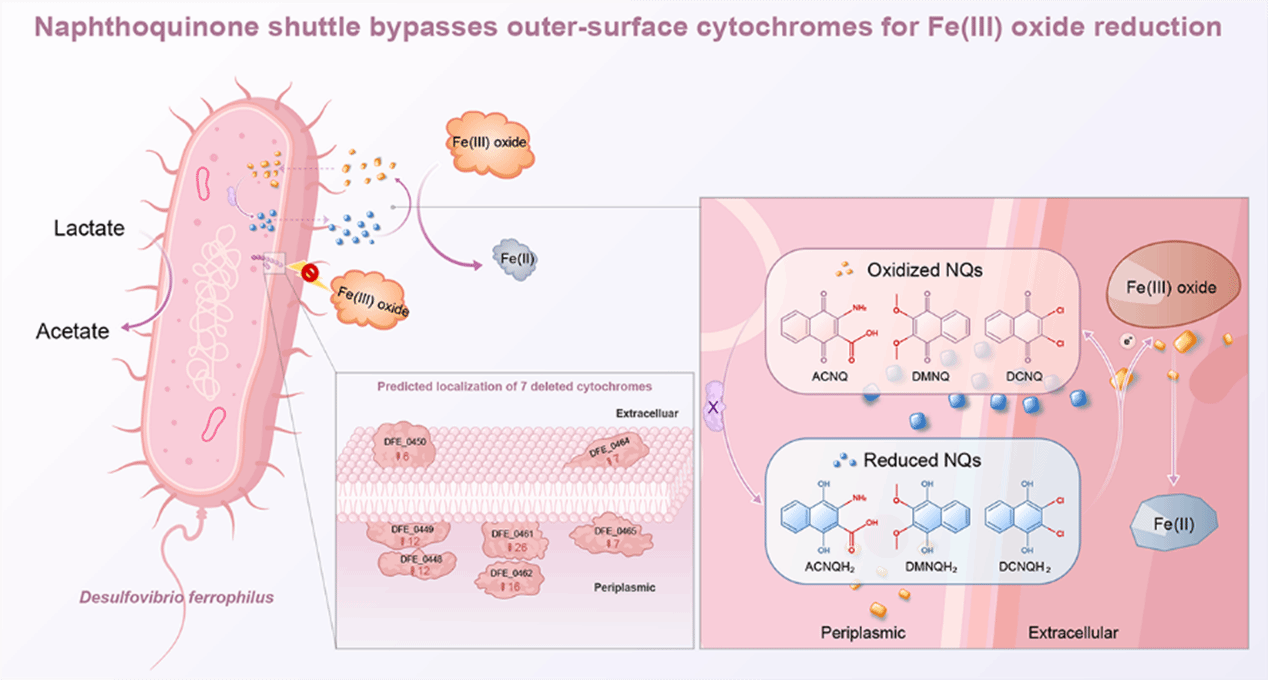
Graphical Abstract: Schematic Diagram of the Iron Oxide Reduction Mechanism inDesulfovibrio ferrophilus


