A research team led by Professors Zhou Dengshan, Zhang Deliang, and Qin Gaowu from the School of Materials Science and Engineering at NEU has made significant progress in the study of non-steady-state plastic deformation in Al-Mg-Zn-based cross aluminum alloys. Their findings were published in the prestigious materials science journal Acta Materialia under the title: “Interplay of dynamic strain aging and dynamic precipitation in the Portevin-Le Chatelier effect in an Al-Mg-Zn-based cross aluminum alloy.” The paper’s first author is PhD candidate Zhang Xiuzhen, and Professor Zhou Dengshan serves as the corresponding author. Co-authors include Dr. Li Yue, Dr. Wei Shaolou, and Professor Dierk Raabe from the Max Planck Institute for Sustainable Materials, Germany, Assistant Professor Yang Chao from Shanghai Jiao Tong University, and Dr. Gong Wu and Dr. Stefanus Harjo from the J-PARC center (Japan).
Traditionally, the materials science community has believed that edge dislocation–solute atom interactions govern dynamic strain aging (DSA) and the Portevin–Le Chatelier (PLC) effect. The team’s latest research on high-solute Al-Mg-Zn–based cross aluminum alloys overturns the conventional view, showing that plastic deformation is in fact dominated by screw dislocations.
Using high-Mg Al-Mg-Zn-based cross solid-solution alloys as model materials, the study combined room-temperature tensile testing (strain rates: 0.00005–0.1 s⁻¹), high-energy XRD line-profile analysis, TEM weak-beam dark-field imaging, and 3DAPT. The results showed that screw dislocations govern plastic deformation and work synergistically with solute atoms to control the serrated flow patterns. During the early stage of deformation, screw dislocations constitute over 60% of the total dislocations (Figure 1) and gradually decrease with increasing strain, in sharp contrast to the classical edge-dislocation-dominated view. The study further revealed strain-rate-dependent mechanisms: at high strain rates (0.1 s⁻¹), screw dislocations undergo frequent local cross-slip, forming microscopic slip bands and triggering type-A serrations. At low strain rates (0.0001 s⁻¹), DSA-assisted dynamic precipitation of Mg-Zn clusters occurs. These solute clusters interact strongly with gliding screw dislocations, suppress cross-slip, promote the formation of a Taylor lattice, and ultimately lead to type-C serrations (Figure 2).
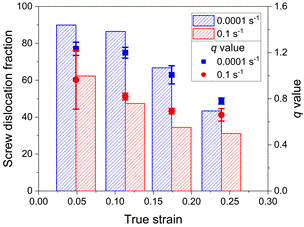
Figure 1: Fraction of screw dislocations and the evolution of the q value with strain at different strain rates
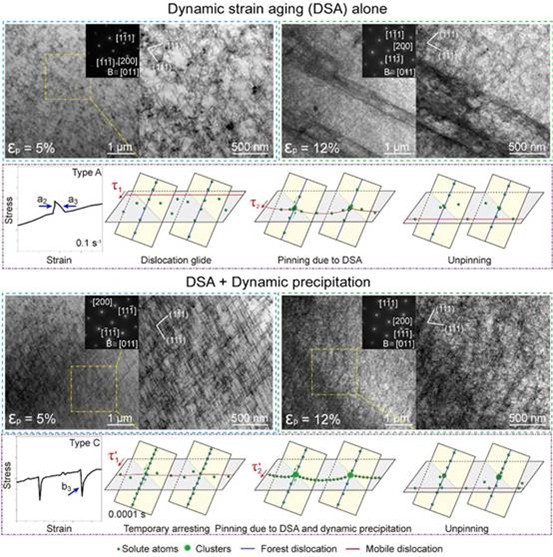
Figure 2: Schematic of dislocation structures and dislocation–solute interactions under type-A and type-C serrations
Since classical flow stress models consider only the interactions between dislocations and solute atoms, the team developed a new constitutive model for flow stress that accounts for the synergistic strengthening effect of mobile and forest dislocations under DSA.
Compared with traditional models, the new model more accurately predicts the flow behavior of the alloy over a wide strain-rate range (0.00005–0.1 s⁻¹), as shown in Figure 3.
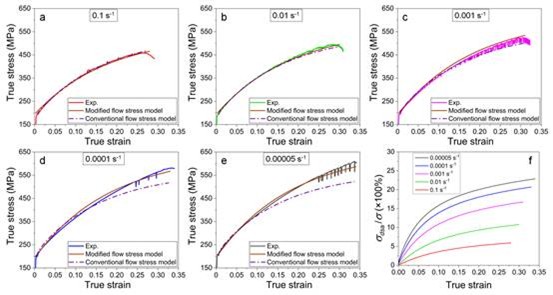
Figure 3: Theoretically predicted flow curves of DSA-type Al-Mg-Zn-based cross aluminum alloys at different tensile strain rates
These findings not only advance the understanding of non-steady-state plastic deformation in high-solute solid-solution alloys but also provide fundamental experimental data for theoretical modeling of their flow behavior.


