Recently, Professor Wang Cong's research team from the School of Metallurgy at NEU received official notification from the American Welding Society (AWS) that their research findings have been selected for the 2026 James F. Lincoln Gold Medal Award. This marks the first time since the award's establishment in 1936 that a research team from the Chinese mainland has been honored as the first completion unit.
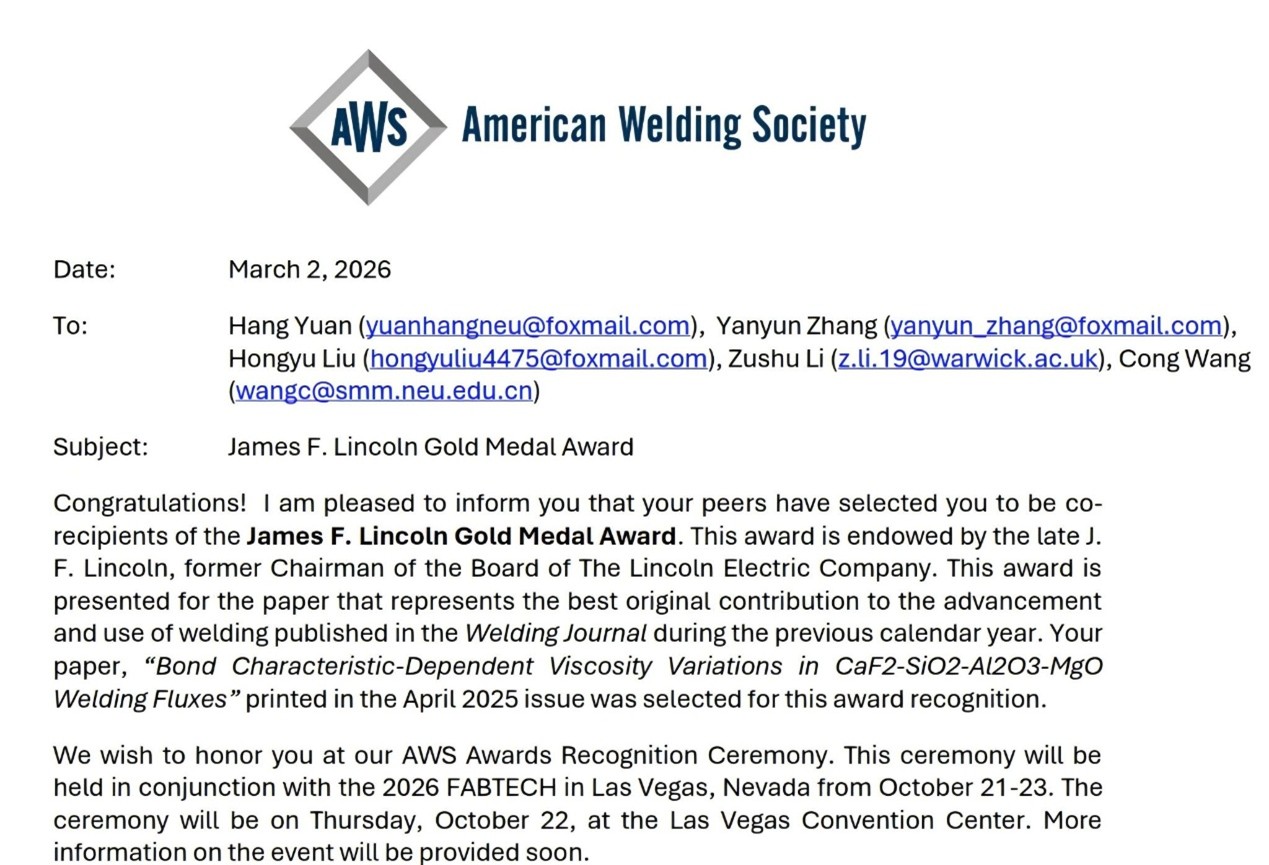
The award, funded by The Lincoln Electric Company, is specifically granted to the best original academic paper published in the official journal Welding Journal during the preceding year. It commends the best original contribution to the advancement and use of welding, standing as one of the most influential academic honors in the international field of welding and materials joining.
The award-winning paper, titled “Bond Characteristic-Dependent Viscosity Variations in CaF₂–SiO₂–Al₂O₃–MgO Welding Fluxes” (https://doi.org/10.29391/2025.104.009), was published in the April 2025 issue of Welding Journal. NEU is the first signature unit for the paper. Professor Wang Cong is the corresponding author; Dr. Yuan Hang is the first author, and Associate Professor Zhang Yanyun, doctoral candidate Liu Hongyu, and Professor Li Zushu from the University of Warwick are co-authors. AWS is one of the world's most influential academic organizations in the field of welding. With over a century of publication history, Welding Journal holds significant academic influence in the welding segment, maintaining rigorous standards for the originality, systematic approach, and engineering guidance value of published papers.
This study centers on the typical industrial CaF₂–SiO₂–Al₂O₃–MgO flux system, establishing a research framework that integrates viscosity experiments with molecular dynamics simulations. It systematically reveals the intrinsic coupling mechanism between the structural evolution of the flux and its macroscopic rheological behavior. The study begins at the microstructural scale of "O/F bond characteristics," elucidating the synergistic regulatory role of free F and bonded F during network dilution and structural depolymerization. It establishes a structure-viscosity correlation model with clear physical significance and predictive capability. This model quantitatively explains the viscosity variation patterns in different fluoride-containing slag systems, providing theoretical support for the design of high-efficiency fluxes and the precise control of high-temperature slag fluidity.


