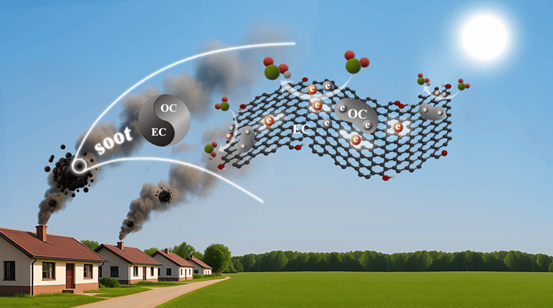
Recently, the research team led by Professor Han Chong from the School of Metallurgy at NEU made significant progress in elucidating the mechanism by which the microstructure of soot regulates the photochemical conversion of NO₂ to HONO. The findings were published in the internationally renowned academic journal Journal of the American Chemical Society (JACS) under the title “Microstructure-Mediated Electron Transfer Dominates the Photoconversion of NO₂ to HONO on Soot.” NEU was the sole completing unit; doctoral student Lai Shiwei was the first author, and Professor Han Chong was the corresponding author.
HONO photolysis is a major source of atmospheric •OH; as a key reactive species in atmospheric oxidation processes, •OH promotes the formation of secondary pollutants and exacerbates air quality deterioration. The photochemical reduction of NO₂ at soot interfaces is considered a major source of HONO in the atmosphere. Due to the extreme complexity of soot’s composition and microstructure, there is still a lack of clear understanding regarding the specific mechanism by which it contributes to the photochemical conversion of NO₂ into HONO. By integrating kinetic analysis, photoelectrochemical characterization, microstructural analysis, and quantum chemical calculations, this study systematically elucidates the mechanism by which HONO is formed through the photochemical reaction between soot and NO₂ emitted from typical biomass combustion sources. The results indicate that the NO₂ uptake coefficient and HONO formation flux exhibit a significant linear positive correlation with the intensity of photo-generated electrons on the soot surface, confirming that the photochemical conversion of NO₂ to HONO is dominated by electron transfer processes. Analysis of the microstructure of soot indicates that greater graphite layer curvature and shorter striation lengths help expose active sites for NO₂ reduction. Defects at the edges and on the surface of graphite layers are key structural regions for photo-generated electrons, and oxygen-containing functional groups act as electron transport pathways, facilitating the efficient transfer of electrons to NO₂. The elemental carbon and organic carbon in soot can form a Type II heterojunction, driving the directed migration of electrons and effectively suppressing electron–hole recombination, thereby further enhancing the efficiency of HONO generation. This study established a quantitative relationship between the microstructure of soot, photo-generated electrons, and reactivity, providing a crucial scientific basis for a deeper understanding of the reactivity of soot in the atmosphere and its environmental impacts.
This work was supported by the National Program for High-Level Overseas Talents, the National Natural Science Foundation of China, the Liaoning Provincial Natural Science Foundation, the Liaoning Talents Program, the Special Fund for Basic Scientific Research of Central Universities, and the NEU Analytical Testing Center.