Associate Professor Zhang Zhipeng from the School of Materials, Northeastern University, in collaboration with Professor Ma Chunfeng of South China University of Technology, recently systematically reviewed the latest advances in topology-regulated polyurea, covering its synthesis, fabrication, and emerging applications. The resulting paper, entitled “Topology-Regulated Polyurea: From Structural Design to Emerging Applications,” was published in Advanced Materials, one of the world’s leading journals in materials science. Associate Professor Zhang Zhipeng is the first author, and Northeastern University is listed as the first affiliation.

As an important class of high-performance elastomers, polyurea is renowned for its outstanding strength, exceptional toughness, and remarkable strain-rate sensitivity, making it indispensable for applications such as impact protection, coating materials, and adhesives. In particular, its unique combination of programmable mechanical properties, strong interfacial adhesion, and dynamic self-healing capability has endowed polyurea with tremendous potential for emerging applications in flexible electronic devices, solid-state electrolytes, soft robotics, and biocompatible sensors. Despite these advantages, polyurea continues to face several key challenges, including the excessively rapid reaction between isocyanates and amines, limited structural tunability, and limited functional diversity, highlighting the need for further breakthroughs.
In recent years, research on polyurea has increasingly focused on the development of innovative synthetic approaches, topological network regulation, and the expansion of functional applications. To address the challenges associated with the rapid reaction between isocyanates and amines, as well as the toxicity of isocyanates, researchers have developed less reactive amine compounds and environmentally friendly non-isocyanate synthetic routes. By rationally designing the topological network—such as incorporating supramolecular segments, hyperbranched crosslinkers, or metal-coordination structures—it is possible to systematically regulate microphase separation, hydrogen-bond density, and segment mobility. These modifications enable the optimization of mechanical properties, including strength, toughness, and elastic recovery, while simultaneously imparting stimuli-responsive functionalities such as damping, self-healing, and shape memory. Leveraging these advantages, polyurea has been successfully extended to emerging applications in flexible electronics, solid-state electrolytes, and intelligent structural devices. From the perspective of polymer science, this review systematically summarizes the molecular origins, synthetic strategies, topological regulation, and property–application relationships of functional polyurea. It covers synthesis and fabrication, network structure design, structure–property relationships, and emerging functional applications, and concludes with an outlook on future development directions, with the aim of providing valuable guidance for continued innovation in this field.
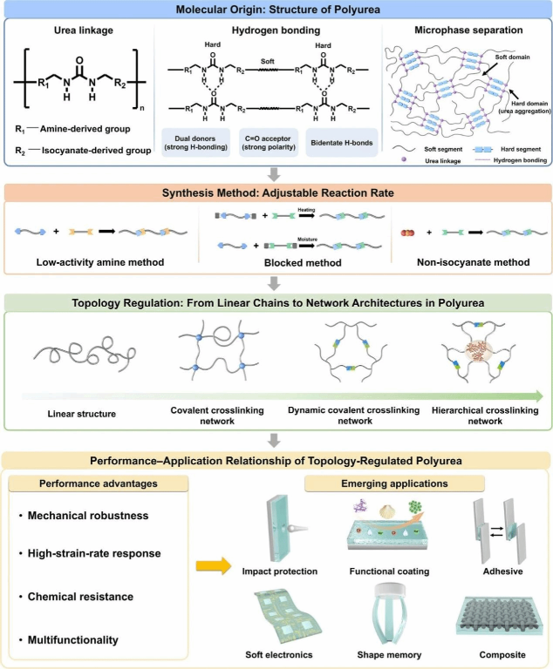
Molecular Origins, Synthetic Strategies, Topological Regulation, and Property–Application Relationships of Topology-Regulated Polyurea


