Recently, the College of Medicine and Biological Information Engineering of NEU has made significant progress in the field of Flexible Electronics. The research achievement, titled “Strain-invariant highly conductive Janus organogels for AI-assisted bioelectronics,” was published in the internationally renowned academic journal Matter under Cell Press. Liu He, Distinguished Associate Research Fellow of the College of Medicine and Biological Information Engineering, is the first author of the paper. Associate Professor Zhang Kai from Shengjing Hospital of China Medical University, Professor Wang Liqiu from The Hong Kong Polytechnic University, and Distinguished Research Fellow Tian Ye from NEU are the co-corresponding authors. NEU is the the first affiliation.
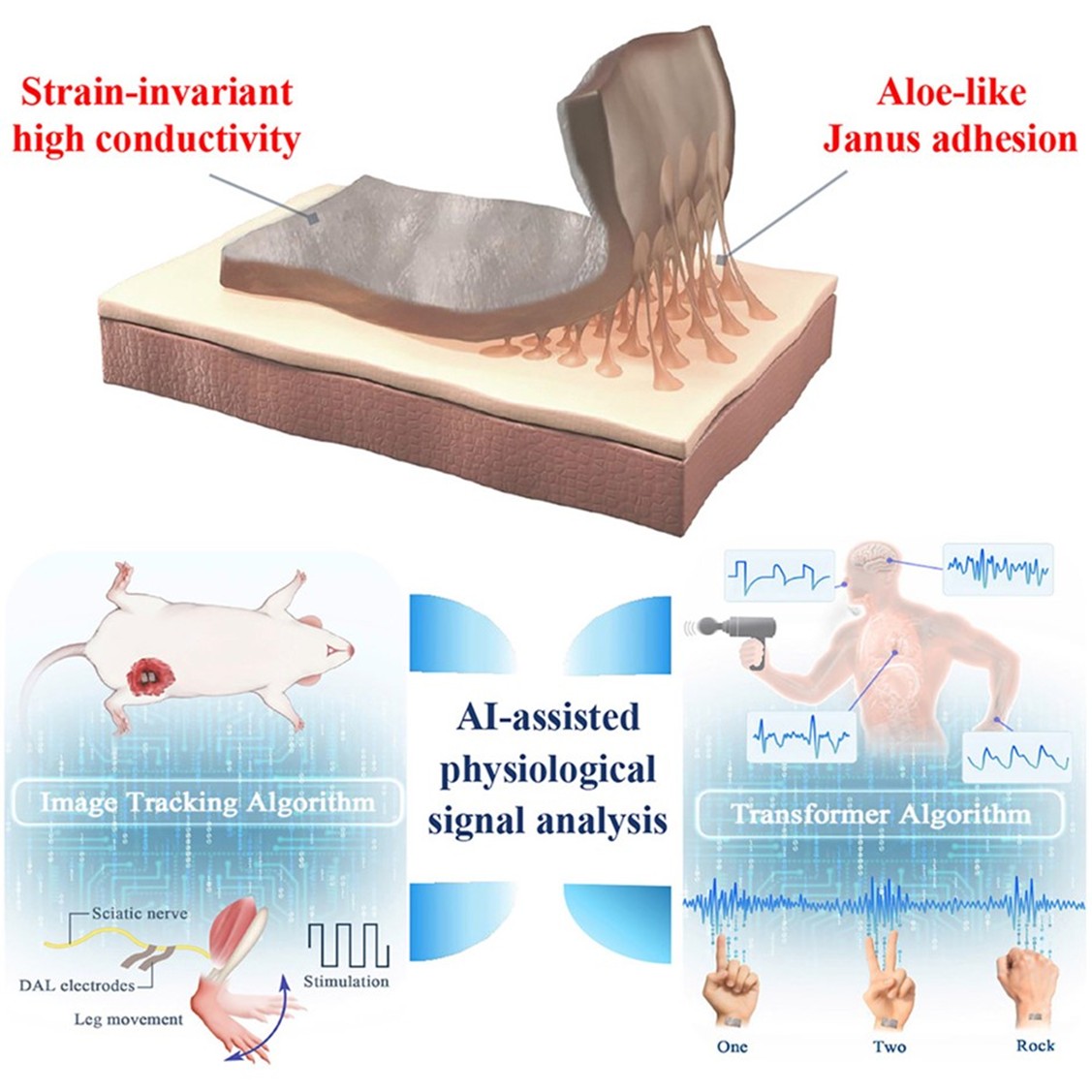
AI-assisted Strain-invariant Highly Conductive Janus Organogels for Flexible Bioelectrodes
The team proposed an inverted gravity annealing strategy to fabricate integrated Organogels that maintain stable performance under 600% strain. The material exhibits ultra-high electrical conductivity (8.0×10⁵ S/m) and a Janus adhesion property (10-fold difference between upper and lower adhesion), enabling its application in AI-assisted anti-interference flexible bioelectrodes. By utilizing the rigid-flexible interlocked percolation network formed during the inverted gravity annealing process, the material maintains a continuous electron tunneling transmission path even under extreme deformation, thereby achieving stable high electrical conductivity under high strain. Meanwhile, this annealing process promotes spatially differentiated aggregation of the metal liquid–solid phases in the upper and lower layers of the material, forming a self-organized asymmetric surface structure and thereby endowing the material with a Janus adhesion property for biointerfaces. In addition to the above unique properties, the Organogels also demonstrate excellent biocompatibility, Tissue-like softness, rapid self-healing ability, and favorable anti-drying performance, giving them broad application prospects in the biomedical field. In in vivo closed-loop neuromodulation experiments, image-tracking algorithms verified that the electrode exhibits significantly improved performance in sciatic nerve stimulation compared with commercial electrodes. In addition, the system enables stable physiological signal monitoring resistant to vibration interference. By integrating the Transformer algorithm, it achieves time series analysis of complex physiological signals (accuracy rate 98.5%). The integration of this advanced flexible electronics material with artificial intelligence algorithms opens a new direction for the development of next-generation biomedical technologies.


