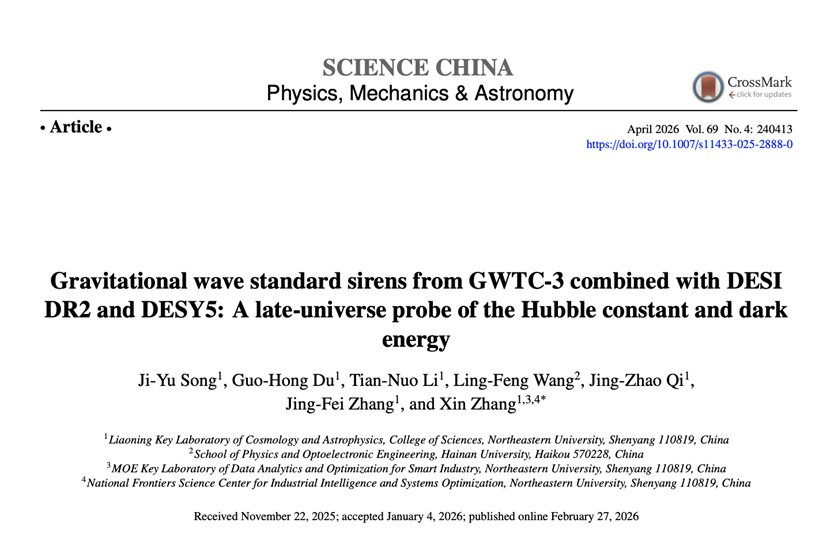
Recently, the team of Professor Zhang Xin at NEU achieved significant breakthroughs in the cutting-edge field of gravitational wave cosmology. The related research paper was published in the English edition of the internationally renowned academic journal SCIENCE CHINA Physics, Mechanics & Astronomy. The team proposed combining data from three categories of the late universe observations—gravitational wave "standard sirens," Baryon Acoustic Oscillations (BAO), and Type Ia supernovae—to conduct a joint analysis. Without relying on the early universe observations or traditional distance ladder calibrations, they placed joint constraints on the Hubble constant and the properties of dark energy based on actual gravitational wave data, offering a new approach to resolving the Hubble constant crisis and understanding the nature of dark energy.
How fast the universe is expanding and whether dark energy evolves over time are among the most pressing questions in modern cosmology. The Hubble constant can be understood as a key parameter describing the current rate of the universe's expansion. For a long time, there has been a significant discrepancy between the values of the Hubble constant derived from the early universe observations (cosmic microwave background radiation) and those derived from the late universe observations (cosmic distance ladder). This discrepancy has been known as the “Hubble constant crisis,” which has puzzled the cosmological community for nearly a decade. Meanwhile, the latest observations from the Dark Energy Spectroscopic Instrument (DESI) indicate that dark energy may not be a cosmological constant with a constant density throughout cosmic time. Rather, there appear to be signs that its density is evolving, and a phenomenon known as “phantom crossing” (“spooky” dark energy behavior) has been observed. Against this backdrop, determining how to independently measure the Hubble constant and the properties of dark energy using only the late universe observations has become a major focus of international cosmological research.
To address this issue, the team developed a brand-new joint analysis framework specifically for the late universe. Building on the joint analysis of traditional baryonic acoustic oscillations and Type Ia supernovae, the team further incorporated gravitational wave standard sirens data from the third gravitational wave transient catalog. Unlike the first two categories of observations which primarily provide measurements of relative distances, the gravitational wave standard siren can directly measure absolute luminosity distances, effectively serving as a “calibrated ruler” for measuring the universe. The combination of these three types of probes has effectively alleviated the degeneracy problem among relevant cosmological parameters. It has also freed research from reliance on early universe data and traditional distance ladder calibrations, enabling a joint measurement of the Hubble constant and the equation of state of dark energy based solely on late universe data.
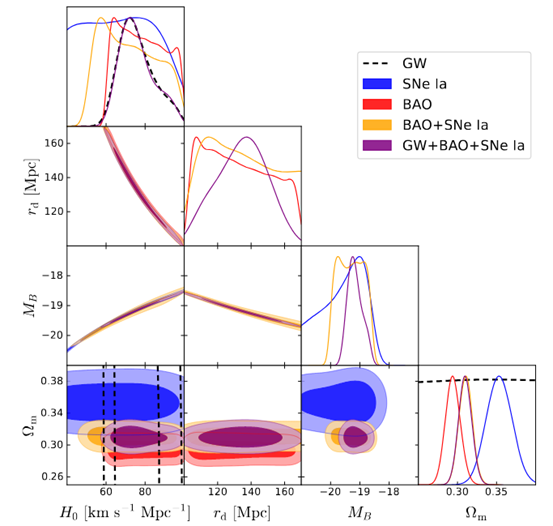
Figure 1: Two-dimensional posterior distributions of the Hubble constant, acoustic horizon scale, absolute supernova magnitudes, and matter density parameters for different data combinations under the standard cosmological model.
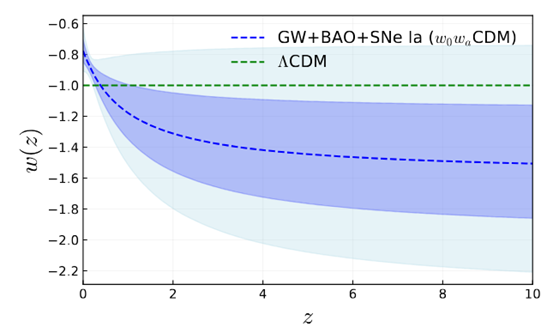
Figure 2: Reconstructed results showing the variation of dark energy equation-of-state parameters with redshift.
The results indicate that, under a kinetic dark energy model, the team’s measurements of the Hubble constant are in excellent agreement with distance ladder measurements and supports, at a confidence level of approximately two standard deviations, the possibility that dark energy may vary with the evolution of the universe. Further analysis reveals that dark energy exhibits a mild “phantom crossing” behavior around a redshift of approximately 0.5. This study marks the first time that real gravitational wave data have been combined with traditional late universe observations, providing joint constraints on the Hubble constant and the equation of state of dark energy, and offering new empirical support for the application of the gravitational wave standard sirens in multi-probe cosmology research.
This research was conducted with support from platforms such as the Liaoning Provincial Key Laboratory of Cosmology and Astrophysics and the National Frontier Science Center for Industrial Intelligence and System Optimization. It was funded by the National Natural Science Foundation of China (Key Projects and General Projects), the SKA Special Project under the National Key Research and Development Program, and the China Manned Space Program (Space Station Survey Telescope Project). In recent years, the Gravitational Wave Cosmology Research Team at NEU has continued to focus on areas such as gravitational wave parameter estimation, cosmological parameter constraints, and machine learning applications. The team has published a series of original findings in top-tier international journals, establishing distinctive research features and academic strengths.
In the future, the team will capitalize on the opportunities presented by China’s space gravitational wave detection program to further advance multi-messenger gravitational wave cosmology research, contributing the wisdom and strengths of NEU to resolving the Hubble constant crisis, uncovering the nature of dark energy, and refining theories of cosmic evolution.


