Recently, the research group led by Professor Xu Dakai from the Team of Professor Wang Fuhui at the School of Materials Science and Engineering, NEU published a systematic review of advances in metallic materials resistant to microbiologically influenced corrosion. The review examines corrosion mechanisms, alloy design strategies, and future research directions. The related achievement, titled “Microbiologically Influenced Corrosion-Resistant Alloys: Mechanisms and Design Strategies,” was published online in the international academic journal Advanced Functional Materials. NEU serves as the first affiliation and the sole corresponding affiliation for the paper. Specially Appointed Associate Researcher Li Jiaqi, Specially Appointed Researcher Cui Miaomiao, and PhD candidate Yu Hang are co-first authors. Professor Xu Dakai and Associate Professor Wang Di are co-corresponding authors.
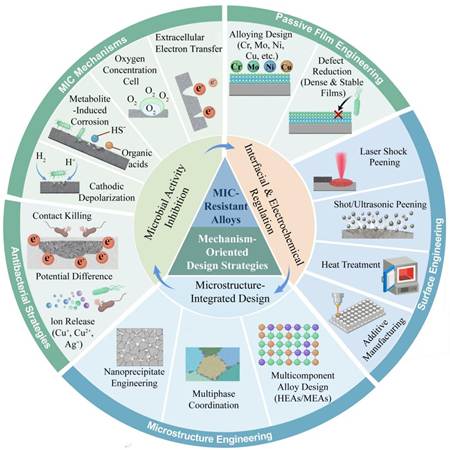
Schematic Illustration of the Design Framework for Microbiologically Influenced Corrosion-Resistant Alloys
The article reviews the mechanisms and research progress of three design strategies. The first strategy is microbial activity inhibition. By introducing alloying elements such as Cu, Ag, Cr, and rare earth elements, this approach inhibits bacterial adhesion and biofilm formation through mechanisms such as the release of antimicrobial metal ions, contact bactericidal action by copper- or silver-rich second phases, the generation of reactive oxygen species driven by micro-potential gradients, and the disruption of bacterial metabolism. The second strategy is interfacial and electrochemical regulation, which employs passivating elements such as Cr, Ni, Mo, and Cu to form dense, high-impedance passive films. It also integrates laser shock peening, ultrasonic shot peening, additive manufacturing, and heat treatment to eliminate surface microgalvanic defects and inhibit extracellular electron transfer. The last strategy is microstructure-integrated design, which enhances antibacterial activity, pitting corrosion resistance, and hydrogen embrittlement resistance by tailoring nanoprecipitates, coordinated duplex or multiphase structures, and the compositions of high-entropy alloys (HEAs) or multi-element alloys (MEAs), while maintaining mechanical properties and passive-film stability. In addition, the article proposes a top-down, integrated prevention and control strategy spanning microbial genetic modification, self-healing surface design, and artificial intelligence (AI)-assisted alloy development. It provides valuable guidance for developing metallic materials resistant to microbiologically influenced corrosion for use in ocean engineering equipment, oil and gas transportation facilities, and biomedical devices.


