Recently, teams led by Professors Zhang Deliang and Zhou Dengshan from the School of Materials Science and Engineering, NEU, together with the team led by Professor Qin Gaowu from Shenyang University of Chemical Technology, proposed a solid-state recycling strategy assisted by electroless copper plating for aluminum chips. The strategy effectively eliminates the long‑term restriction imposed by oxide-modified original chip interfaces on solid‑state recycled aluminum materials and realizes the leap of aluminum chips from “downcycling” to “high-performance remanufacturing.” The related achievement was published in Acta Materialia, an authoritative journal in the field of metallic materials, under the title “Solid-state recycling of aluminum chips into high-performance crossover alloys via electroless Cu plating: Oxide elimination and doubled tensile strength.” The paper’s first author is PhD candidate Yu Yuanping. Professor Qin Gaowu from Shenyang University of Chemical Technology, Professor Dierk Raabe from the Max Planck Institute for Sustainable Materials, and Professor Zhou Dengshan and Professor Zhang Deliang from NEU are co-corresponding authors.
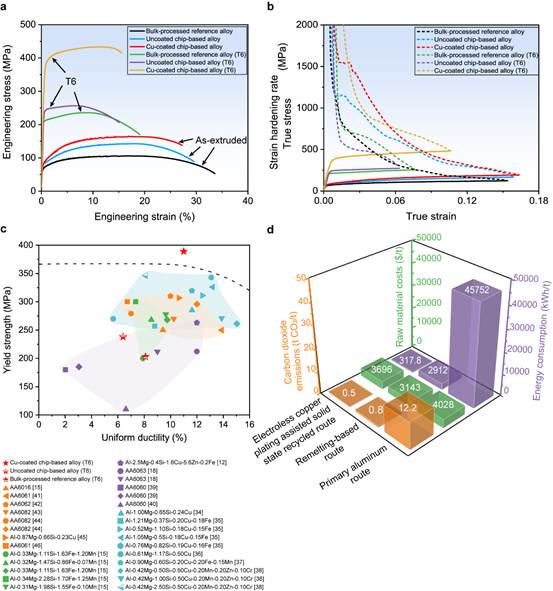
Solid‑state sustainable recycling and life-cycle assessment of AA6063 aluminum alloy chips assisted by electroless copper plating
This electroless copper plating-assisted solid-state route for the sustainable recycling of aluminum chips represents a frontier approach in solid-state metal recycling. Designed for scalability and compatibility with existing extrusion production lines, it simultaneously addresses the challenges of removing interfacial oxides and enabling cross-alloy compositional design. It demonstrates that aluminum chips can be remanufactured into high-performance materials without remelting and provides an engineering-ready technical paradigm for shifting “weight-oriented competition” to “performance-oriented competition” of recycled aluminum while enabling grade-preserving recycling and strengthening industrial-chain resilience.


