Recently, the team led by Professor Yi Tingfeng from the School of Resources and Materials at NEU Qinhuangdao has made important progress in the field of aqueous zinc-ion batteries. The research result, titled “Molecular fence on the inner Helmholtz plane for highly reversible zinc metal anodes” was published in the eScience journal, a high-starting journal under the China Science and Technology Journal Excellence Action Plan (CAS Zone 1, impact factor 52.9). Li Ying, a 2022 doctoral student majoring in Materials Science and Engineering at NEU Qinhuangdao, is the first author of the paper. Professor Yi Tingfeng of NEU Qinhuangdao, Associate Professor Zhang Qianyu of Sichuan University, and Professor Wu Yuping of Southeast University serve as the corresponding authors. NEU is the first completing unit.
Aqueous zinc-ion batteries (AZIBs), with intrinsic safety, environmental compatibility, cost advantages, and high theoretical capacity, have become a highly promising candidate system for sustainable grid-level energy storage. However, zinc metal anodes in traditional zinc sulfate electrolytes face serious problems such as dendrite growth, hydrogen evolution reaction (HER), and corrosion. These problems irreversibly consume the electrolyte, generate insulating by-products, disrupt the uniformity of zinc deposition, and may even penetrate the separator to trigger an internal battery short circuit. Consequently, they lead to low coulombic efficiency and poor cycling stability, severely restricting practical application. Constructing an artificial interface protective layer is an effective strategy to stabilize the zinc metal anode; however, its static characteristics are difficult to adapt to the dynamic volume changes during zinc deposition/stripping, which introduces risks of cracking and failure. In contrast, a more targeted yet less explored mechanism is to construct a dynamic and stable interfacial layer in situ at the molecular scale through an interfacial molecular engineering strategy. This requires molecules to directly reconstruct the inner Helmholtz plane (IHP) through specific adsorption without altering the intrinsic solvation structure of the bulk electrolyte.
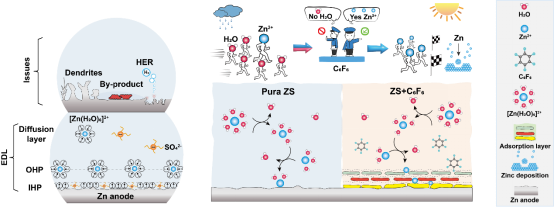
Schematic Diagram of the Mechanism by Which HFB Stabilizes the Zinc Metal Anode as a “Molecular Fence.”
Based on this concept, the study employs a molecular design strategy and uses hexafluorobenzene (HFB) as an electrolyte additive to achieve precise reconstruction of the IHP of the zinc metal anode. Distinct from conventional bulk regulation or macroscopic coating strategies, its core advantage lies in preserving the intrinsic solvation structure of Zn²⁺ while realizing molecular-level interfacial regulation solely through specific interfacial adsorption. Owing to its electron-rich aromatic planar structure, HFB preferentially adsorbs on the zinc surface and reconstructs the originally hydrophilic and highly reactive IHP dominated by water molecules and sulfate ions into a hydrophobic and water-deficient IHP, thereby forming an efficient “molecular fence.” This suppresses the hydrogen evolution reaction and the formation of corrosion by-products at the source, while simultaneously optimizing zinc-ion interfacial transport kinetics and guiding dendrite-free uniform deposition. As a result, the zinc metal anode exhibits ultra-long cycling stability, and the excellent performance of the full cell verifies its potential for practical application. This work shifts the focus of stabilization strategies for metal anodes from bulk phases and macroscopic interfaces to the molecular-scale inner Helmholtz plane, and the proposed mechanism of “specific adsorption-induced IHP reconstruction” provides a new theoretical framework and technical pathway for the molecular design of electrolytes in aqueous zinc batteries.


