Recently, Professor Xu Dake's research group from the team of Professor Wang Fuhui at the School of Materials Science and Engineering, in collaboration with Professor Yang Bo's research group from the team of Professor Zuo Liang, made significant progress in biofouling prevention and control. Their research article entitled "Flatband λ-Ti3O5 Nanoparticles Unlocking Near-Unity Solar Absorptivity for Ultrarobust Photothermal Antibiofouling" was published in the top international Journal of the American Chemical Society (DOI: 10.1021/jacs.6c01139). Doctoral student Li Meng and Researcher Li Xiangyu from the School of Materials Science and Engineering are co-first authors. Professor Xu Dake, Professor Yang Bo, and Researcher Li Xiangyu are co-corresponding authors. NEU is the primary lead institution and the sole affiliation for the corresponding authors.
Photothermal antibacterial technology, due to advantages such as remarkable antibacterial effects and a low propensity to induce bacterial resistance, has become an important approach for addressing the widespread problem of microbial contamination worldwide. However, existing photothermal antibacterial materials generally face key bottlenecks such as low solar energy capture efficiency and insufficient visible light response capability. In response, the study introduces an innovative photothermal antibacterial strategy based on metal-like phase λ-Ti3O5 nanoparticles. Its outstanding performance originates from the material’s unique flatband electronic structure and the significantly enhanced joint density of states near the Fermi level. The research team developed a supramolecular nanoframe-induced synthesis method. This method overcomes the long-standing technical challenge of the controllable preparation of λ-Ti3O5 nanoparticles with high purity, phase stability, and well-ordered structures. Experimental results show that, compared with traditional micron-scale materials, λ-Ti3O5 nanoparticles exhibit a solar absorptivity close to 100%, and their photothermal conversion efficiency increases by 8%. Their excellent photothermal performance mainly arises from the Ti-Ti dimer-induced flatband structure near the Fermi level that is intrinsic to λ-Ti3O5, as well as the pronounced confinement effect of the nanoparticles. Meanwhile, λ-Ti3O5 nanoparticles also exhibit excellent chemical stability and recoverability, and they demonstrate broad-spectrum bactericidal ability against multiple bacteria together with efficient biofilm destruction performance. All-atom molecular dynamics simulation further clarified the synergistic antibacterial and antifouling mechanism. The material first specifically adsorbs onto bacterial surfaces through electrostatic interaction. It then combines photo-induced reactive oxygen species generation with a local rapid temperature rise effect. These processes alter bacterial cell membrane fluidity and membrane structural integrity, which ultimately achieves efficient sterilization. This study systematically revealed for the first time the critical role of Ti-Ti dimer-induced flat bands in improving photothermal antibacterial performance, and it provides a new research perspective for the development of next-generation photothermal antibacterial nanomaterials suitable for diverse bio-interface applications.
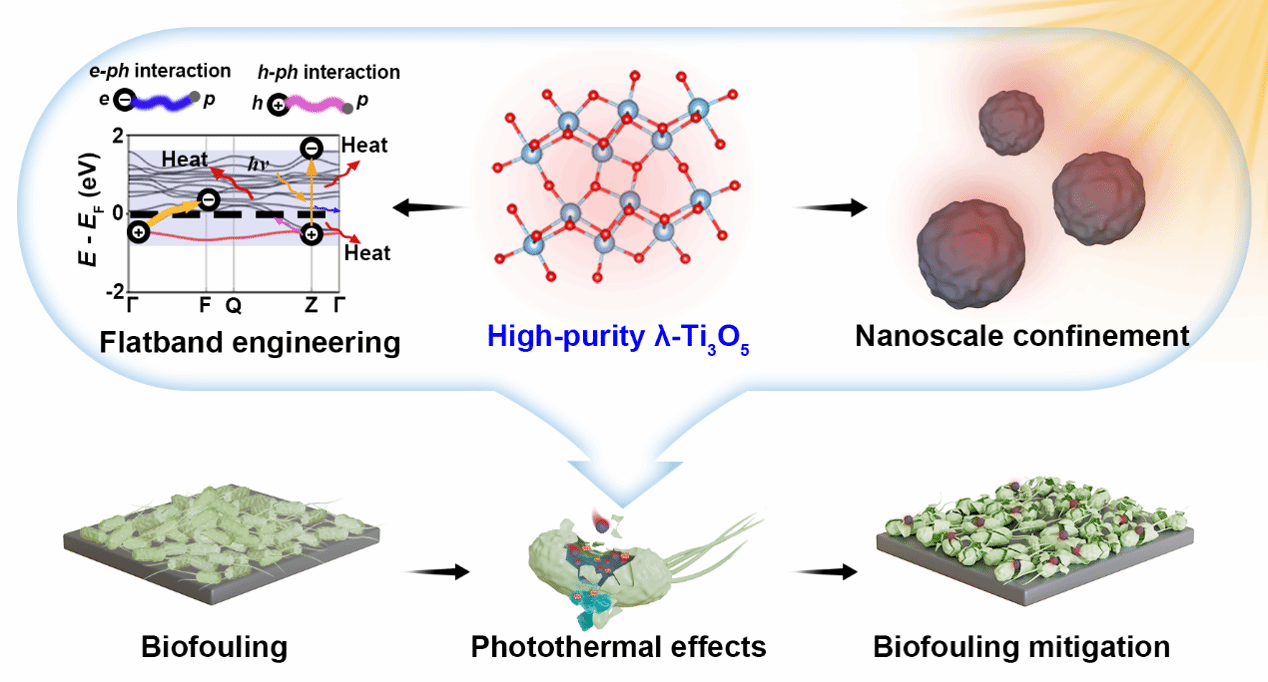
Schematic illustration of the preparation and antifouling performance of λ-Ti3O5 nanoparticles
This work was supported by the National Science Fund for Distinguished Young Scholars, the General Program of National Natural Science Foundation of China, the Youth Science Fund Category C of National Natural Science Foundation of China, the National Key R&D Program of China, the Liaoning Xingliao Talent Program, the China Postdoctoral Innovative Talent Support Program, the General Program of China Postdoctoral Science Foundation, the Guangdong Basic and Applied Basic Research Foundation Offshore Wind Power Joint Fund, the Open Fund of State Key Laboratory of Marine Key Materials, the Open Project of State Key Laboratory of Marine Coatings, and the Fundamental Research Funds for the Central Universities.


