Recently, the research achievements of the group led by Professor Wang Dingyi from the Department of Chemistry, College of Sciences, NEU were published in the international authoritative journal Science Advances. The paper is titled "Enantio-and regioselective nickel/photoredox-catalyzed cross-electrophile coupling of benzylic aziridines with alkynyl bromides." The College of Sciences of NEU is listed as the first completion institution. Doctoral student Lan Hongyan is the first author. Professor Wang Dingyi, Professor Xu Zhaodong, and Professor Lutz Ackermann of the University of Göttingen are the corresponding authors.
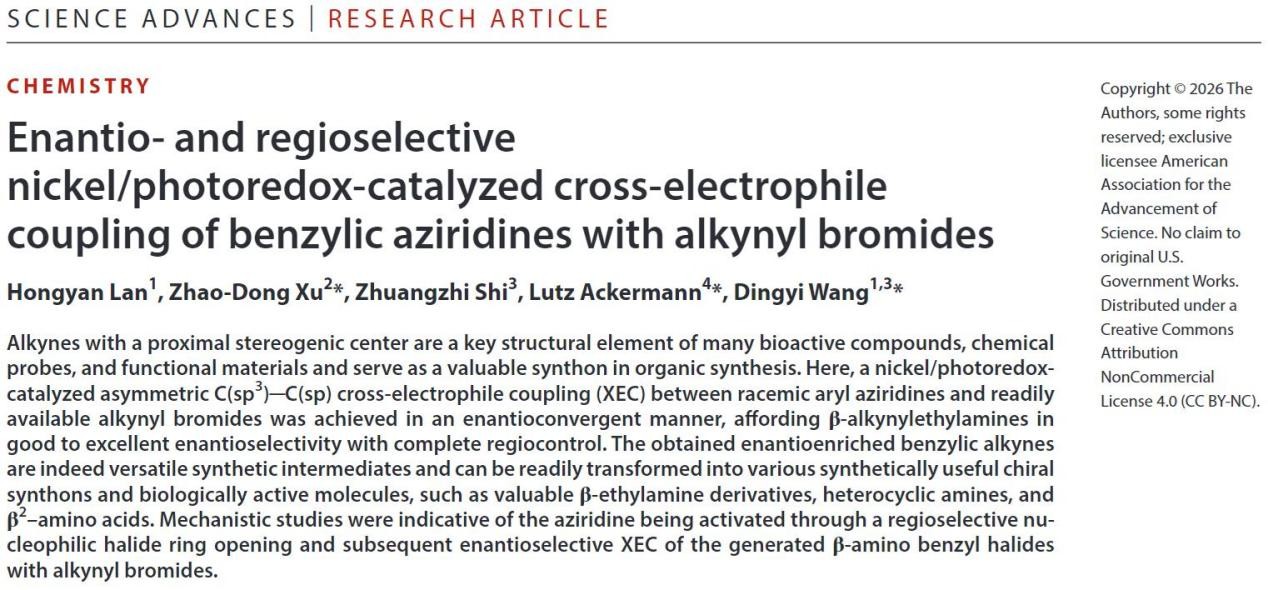
Chiral alkyne structural units are widely found in natural products, drug molecules, and functional materials. In particular, alkynylamine compounds bearing chiral centers have become a research focus in the fields of organic synthesis and medicinal chemistry because they combine the versatile transformation capability of alkynes with the biological activity of amino groups. Therefore, how to efficiently and highly enantioselectively construct C(sp³)–C(sp) bonds to synthesize chiral alkynylamine compounds is of great significance.
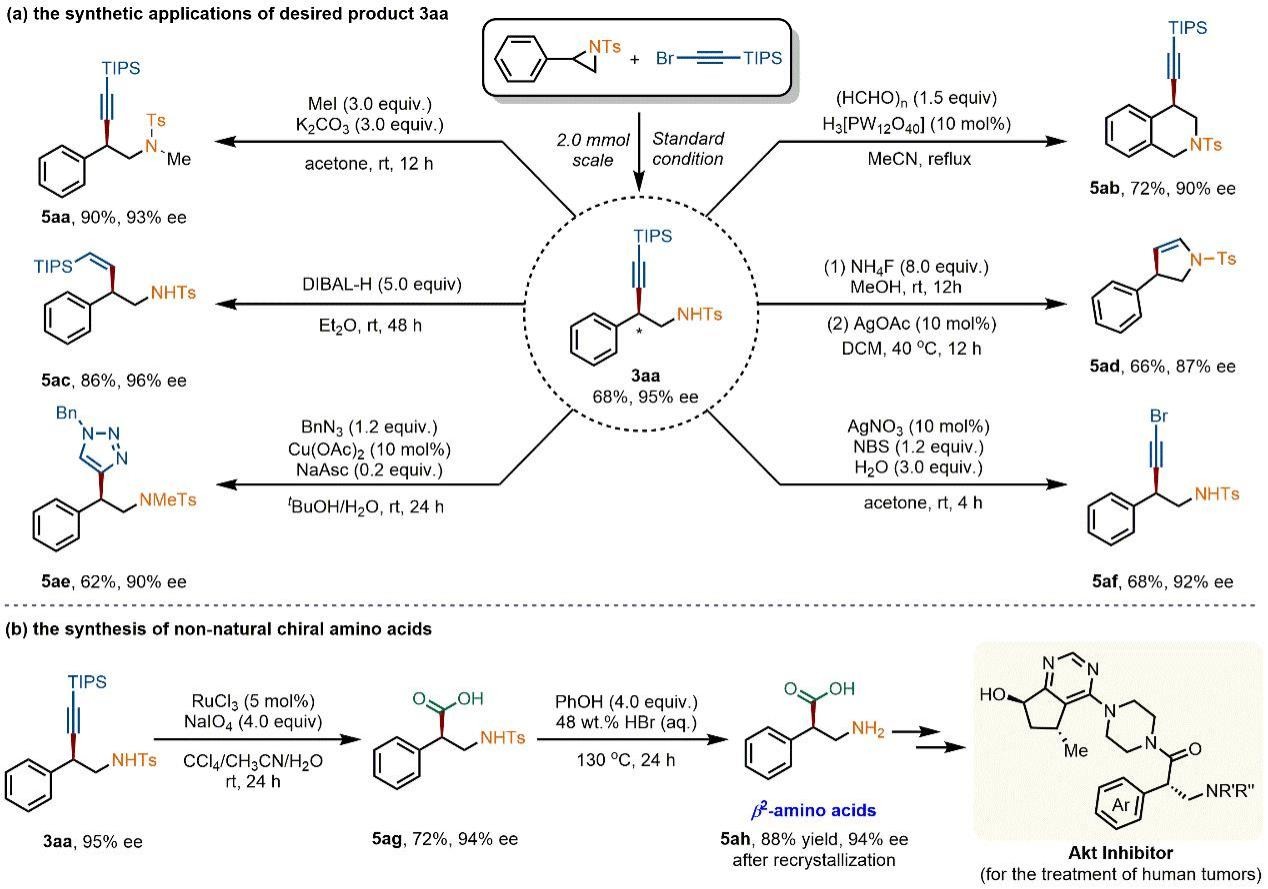
The authors achieved for the first time the enantioconvergent cross-electrophile coupling (XEC) between racemic aziridines and alkynyl bromides via nickel/photoredox co-catalysis, and modularly synthesized a series of novel chiral β-alkynyl ethylamines. The obtained products can be further transformed into a variety of value-added compounds. For example, cyclization reactions generate chiral nitrogen-containing heterocycles; semihydrogenation affords (Z)-enamines; click chemistry constructs triazoles; and Ru-catalyzed oxidation of triple bonds produces chiral β²-amino acids. In particular, the latter provides a new pathway for the synthesis of non-natural amino acids and their related drugs, such as Akt inhibitors.
This work provides a new approach for the development of C(sp³)–C(sp) asymmetric cross-electrophile coupling reactions. Its mild conditions and good compatibility with late-stage modification of drug molecules indicate its broad application prospects in drug discovery and chemical biology.
The Analytical and Testing Center of NEU and the Instrument Sharing Platform of the Chemistry Experimental Center, College of Sciences, provided important support for experimental data acquisition in this work.


