Recently, a study led by Professor Zuo Liang's team from the School of Materials Science and Engineering at NEU in collaboration with Researcher Chen Xingqiu's team from the Institute of Metal Research, Chinese Academy of Sciences, has been published in Nature Communications under the title "Ultrahigh efficiency solar evaporation through orchestrated multiphase flow." Doctoral candidate Tang Ruolan from the School of Materials Science and Engineering is the first author of the paper, with Professor Zuo Liang and Professor Yang Bo serving as corresponding authors.
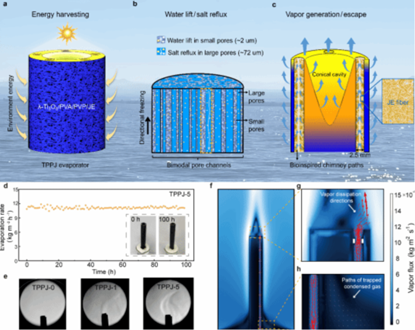
Solar-driven interfacial water evaporation technology shows great application prospects for applications in seawater desalination and high-salinity wastewater treatment. However, existing high-aspect-ratio evaporators still face issues such as insufficient interfacial water supply, restricted vapor diffusion, salt crystallization, and inadequate heat utilization, which constrain their efficient and stable operation. To address these challenges, the research team proposed a physical design framework for orchestrated multiphase flow regulation, integrating and optimizing the four key processes of water replenishment, salt backflow, vapor escape, and heat transfer, providing new insights for the construction of efficient solar evaporators.
The research team achieved efficient capillary water supply by constructing a polyvinyl alcohol/polyvinylpyrrolidone (PVA/PVP) hydrogel with a bimodal pore structure. The Marangoni effect induced by salt concentration and temperature gradients effectively inhibited salt crystallization. The introduction of the perforated structure of superhydrophobic Juncus effusus (JE) stems formed a chimney effect-driven convective flow, significantly promoting vapor escape. Meanwhile, the high-aspect-ratio structure enhanced the evaporator's ability to capture heat from the surrounding environment, achieving synergistic utilization of solar input and environmental heat. The optimized high-aspect-ratio λ-Ti₃O₅/PVA/PVP/JE (TPPJ) evaporator continuously and stably operated in 15.3 wt% high-concentration brine and real seawater for 10 days with no detectable salt crystallization. Outdoor experiments demonstrated that the system achieved a freshwater yield of 39.8 L m⁻² day⁻¹ under natural sunlight for 8 hours, showing excellent structural scalability and potential for practical application.
This research, addressing national strategic needs such as seawater desalination and high-salinity wastewater treatment, proposes a design strategy for efficient solar evaporators based on orchestrated multiphase flow regulation. It not only expands the design concept of solar-driven interfacial evaporation technology but also provides new theoretical support and technical pathways for the large-scale application of green and low-carbon water treatment technology.
This work was supported by the National Natural Science Foundation of China key project, Liaoning Province Major Science and Technology Project, and the Fundamental Research Funds for the Central Universities. The Analysis and Testing Center of NEU provided strong support for this research.